
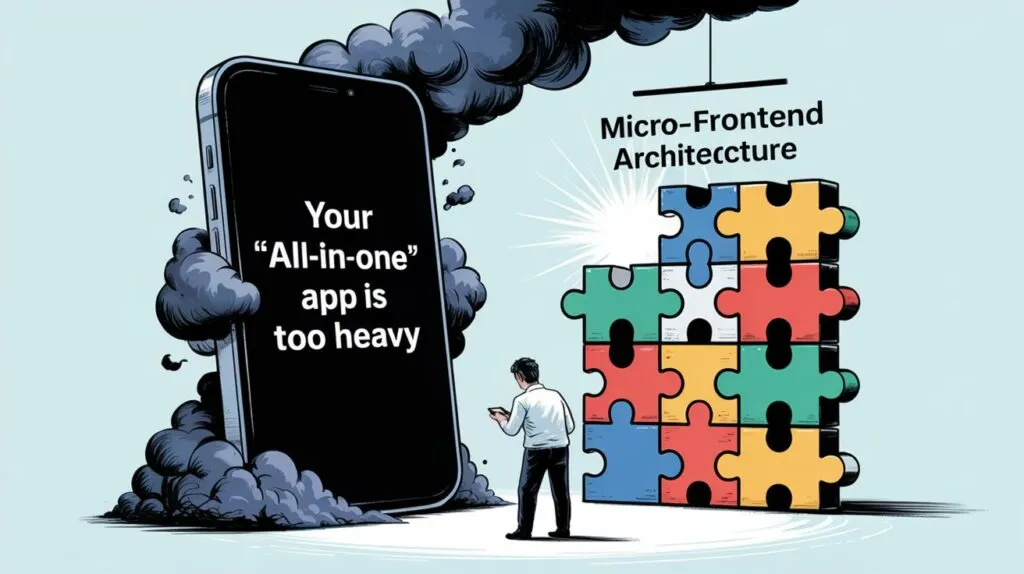
At some point, all successful business application projects face the same problem. A product that was clean and efficient from the start has transformed into a bloated application, chock- full of features, dependencies, and technical debt. The initial idea was to create an "all-in-one" application that does it all. But in 2026, this approach has an unexpected downside. Instead of an efficient application, you get 5-8 second load times, fragile deployments, increasing customer abandonment, and development teams afraid of pushing updates. This is what happens when you choose monolithic frontend architecture.
The Problem: When "All-in-One" Becomes "Too Much"
The Decision Maker's Pain: Speed or Stability?
Are you a CTO, Product Head, or Founder of an application? You've probably received this message before: "It takes 6 seconds for our application to load. Customers are abandoning their carts. And every release is a risk." But what's really going on behind the scenes is:
1. Slow Load Times = Lost Revenue
In today's world, users expect applications to load in less than 2 seconds. Every second lost results in lost revenue and killed conversions, especially for eCommerce and SaaS applications.
2. One Small Change = System-Wide Risk
In monolithic applications, even small changes to the user interface can cause unforeseen problems with other features of the application. This is because everything in a monolithic application is tightly coupled.
3. Development Bottlenecks
Development teams cannot operate independently. One deployment pipeline, one codebase, one release process. The pace of innovation suffers.
4. Scaling Becomes Painful
Adding new features to a monolithic application does not increase complexity linearly. It increases exponentially. This is not just a technical problem. It's a business problem.
What is a Micro Frontend Architecture?
A micro frontend architecture is similar to a microservice architecture. In a microservice architecture, you split up a large application into smaller, independent "mini-apps." In a micro frontend architecture, you split up the user interface of a large application into smaller, independent "mini-apps." For example: • Cart • User Profile • Product Feed • Checkout • Notifications Each of these "mini-apps" can be thought of as independent applications with their own codebases.
Why Micro-Frontends Solve the Performance Problem
1. Faster Load Time with Lazy Loading
Instead of loading the entire application, we only load what is necessary. Want to go to the homepage? Load the feed. Want to go to the checkout page? Load the checkout module. This is much faster.
2. Independent Deployments = Zero Fear Releases
Updating the cart has zero effect on the profile. They are independent. This means faster release times, less fear, and more continuous delivery. Your dev team will stop fearing releases.
3. Better Team Productivity
Different teams can own different pieces of the application. For example: • Team A: Owns the checkout module • Team B: Owns the search module • Team C: Owns the user dashboard module
No team is stepping on the toes of another team.
4. Technology Flexibility
Micro-frontends enable different technology stacks in different parts of the application. While many companies are using React and other frameworks, micro-frontends provide the flexibility needed to move forward without changing everything in the application. This is important for scalability.
Micro-Frontends + Mobile: A Game Changer with React Native
The benefits of using micro-frontends are not limited to web applications. Micro-frontends can be used in mobile applications as well. They can be used in conjunction with optimization techniques in React Native. Here's how: • Modular Bundling: You're not shipping the massive app bundle, but rather smaller, feature- specific bundles. • Faster App Startup: By reducing the initial payload size, you're improving the app startup time, which is essential for user retention. • Targeted Updates: You're also able to send targeted app updates to specific modules, rather than having to go through the entire app update cycle.
Real-World Use Case: Solving the 6-Second Load Time Problem
Before: Monolithic App Architecture • Initial Load: 6 seconds • Entire app bundle was 5MB+ in size • One deployment pipeline • High cart abandonment After: Micro-Frontend Architecture • Initial Load: ~2 seconds • Lazy-loaded modules • Independent deployments • Faster feature rollouts Results: Improved Conversion Rates, Lower Bounce Rates, and a Much Happier Development Team. This is the new standard in the industry for scalable enterprise apps.
When to Use Micro-Frontends
Not all projects are suitable for using micro-frontends. Consider them if you are facing any of the following problems: • Managing your frontend codebase is difficult • Releasing code is taking too long • There are multiple teams working on the same application • Performance problems are affecting user experience • Adding new features is taking too long If you are facing 2 to 3 out of these problems, then you are facing a monolith problem.
Misconceptions
"It's Too Complex": Yes, using micro-frontends is complex. But using them is less complex than managing a bloated monolith. "We Need to Rewrite Everything": No, we do not need to rewrite everything. We can start with one part of our application, like the checkout part, and then move on to other features. "It's Only for Big Tech": No, this is not true. We can use this in small, medium, or large companies because the cost of not doing this is much more.
The Bottom Line: Build for Scale, Not Just Launch
The real question isn't "Should we use micro-frontends?" The real question is "Can our current architecture handle the next 10x growth?" If your application is slowing down your business, then the answer is a definitive no. Micro-frontends are not just a technological advancement, but a strategic advantage for any organization.
Let's Fix Your App Before It Costs You More
If your application is taking too long to load, losing users at critical steps, or slowly slowing down your development team, then it is time for you to think about a new application architecture. At IntelliSource, we are experts in transforming monolithic applications into scalable, high- performance applications using micro-frontend architecture and advanced mobile optimization techniques. We are not in the business of rewriting code, but in delivering business results related to application performance, scalability, and growth.
Blogs:
Explore all blog

Why We Recommend Flutter for 80% of Enterprise Apps
The Flutter vs Native debate is settled in 2026. Discover why IntelliSource recommends Flutter for 80% of enterprise apps — and how it cuts development costs by up to 50%.

Mobile App Trends 2026: What Businesses Need to Know for the App Development Future
From AI integration and 5G to AR/VR and security-first design, explore the mobile app trends 2026 that businesses need to understand to stay ahead in the app development future.

Mobile Application Development for Businesses: A Complete Guide
In the current business world that is quickly changing, mobile applications have become indispensable tools for companies who want to remain efficient, relevant, and connected with their clientele base. Mobile applications present organizations with substantial opportunities because they let businesses connect with clients more effectively while making their operations smoother.