
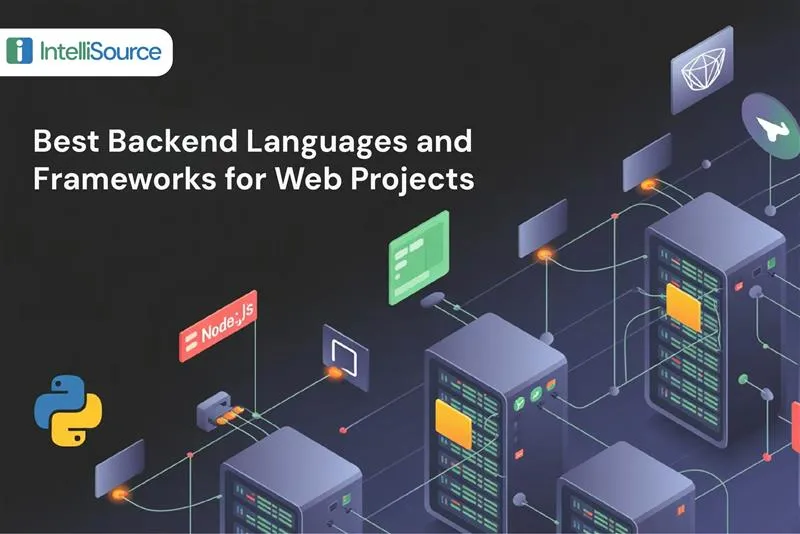
The backbone of any successful web project is a strong backend that supports the functionality, performance, and scalability of the project. With the growing richness and complexity of digital experiences, programming languages and frameworks are increasingly important in fulfilling current needs.
The backend ecosystem is changing rapidly, whether through established proven technologies or up-and-comers. In this blog, we shall discuss thebest backend languages of 2025.
Criteria for Choosing Backend Stack
- Performance and Scalability
The selected framework and language of the backend should be able to support large traffic loads with a smooth scaling effect. A stack with rapid response times and the ability to expand with the user demand is a long-term business asset.
- Integration and Ecosystem
The new projects require seamless interaction with APIs, databases, and cloud infrastructure, ensuring reliability, scalability, automation, monitoring, integration, and efficient real-time performance. A stack that has good ecosystem support is a choice that assists in providing efficient software development solutions and eliminates the tension of integrating various services.
- Security Features
Security has to be established at the base. Applications are safer in languages and frameworks that have strong authentication measures, encryption facilities, and vulnerability patching procedures.
Top Backend Languages in 2025
The subsequent programming languages still lead the pack in backend development. All have their own strong points depending on the project.
Python
Python remains one of the best backend frameworks for web projects, especially for businesses that are interested in fast prototyping and clean code. It is easy to use and to read, which is why it is a favorite among both start-ups and enterprises.
Its ecosystem has such powerful frameworks as Django and FastAPI that are popular for creating scalable and secure applications. The versatility of Python also leaves it applicable to AI-based web platforms, with both backend and machine learning.
Python has become the most popular programming language in web and data-driven solutions, as the JetBrains 2024 Developer Survey shows that it is among the top three most widely used programming languages in the world.
JavaScript / Node.js
The language is also the winner in thetop backend languages and frameworkscategory due to the presence of Node.js which introduces the language to the server side. This end-to-end functionality simplifies the development process and also makes it possible to share libraries between the frontend and the backend.
Node.js is an event-driven, as well as non-blocking, architecture, and thus it is particularly useful in real-time applications like chat applications and online collaboration tools. It still reigns in scalability- and user-interactive industries.
Statista states that JavaScript is the most popular programming language among programmers all over the world, and it has taken its place in modern web projects.
Java
Java is also a force to be reckoned with when it comes to the top backend languages and frameworks,with its unparalleled stability and widespread use in businesses. It powers large systems, including banking systems, healthcare software, and enterprise software, which are critical to business operations.
It features a JVM (Java Virtual Machine) that provides platform independence, and frameworks like Spring Boot make it easy to develop, allowing for scalability and optimal performance. Java is still preferred by organizations that care more about reliability.
According to the TIOBE Index, Java has consistently ranked among the world's top programming languages, demonstrating its long-term performance in enterprise-scale applications.
Go
Go, also known as Golang, is becoming one of the best backend languages 2025 due to its speed and efficiency. It was originally created by Google, so it is concurrently processed and therefore suited to cloud services and microservice architecture.
It is simple and minimizes development time, and its high performance makes it a favorite among startups that grow rapidly. Go also has good adoption in DevOps tools and distributed systems.
Go is consistently ranked among the highest-satisfied developers, according to the Stack Overflow Developer Survey 2024, which highlights its increasing importance in the development of a backend.
PHP
PHP remains essential to the best backend frameworks for web projects, supporting millions of websites, including WordPress, despite its age. It is widely used, making it suitable for businesses seeking cost-effective solutions.
Laravel and Symphony are the frameworks that improve the development of the PHP language, bringing new architecture, security, and tools that satisfy the enterprise requirements.
W3Techs claims that approximately 77 percent of all the known websites that were developed with server-side languages have been developed in PHP, which is a testament to the undisputed leadership in the web development sector.
C# / .NET
C# remains among the top back-end languages and frameworks, especially in conjunction with the .NET environment at Microsoft. It is also robust when it comes to enterprise integration and the ability to create robust web, desktop, and mobile applications.
The introduction of ASP.NET Core has also made C# as flexible as it has ever been because now the language can be utilized in various platforms. This places it at a good spot when compared to existing SaaS systems and business applications.
The C# programming language is still among the top 10 programming languages on the RedMonk ranking, which proves its continuous existence in the world of developers.
Rust
Rust is quickly emerging as one of the best backend languages in 2025, with high performance and memory safety. It is particularly effective with the projects that require security and control on the system level.
It has a more difficult learning curve than other languages, and its efficiency and library ecosystem remain appealing to developers. Rust is also robust when it comes to handling concurrency without being unsafe.
Rust is already popular and, as of GitHub Octoverse 2024, it has been the most popular language among developers for a few years.
Kotlin
Android Kotlin, which Google supports, is also making inroads in backend development. It is a compelling option due to its terse syntax and compatibility with the JVM, as well as teams that need to switch to Java.
Frameworks enable the developer to create lightweight and modern web applications with reduced boilerplate code. Kotlin is easy to use and, at the same time, high-performing, making it attractive to both startups and enterprise teams.
JetBrains Kotlin Report 2024 states that there is a constant increase in the usage of Kotlin outside the mobile domain, specifically in backend services.
Best Frameworks & Their Strengths
Frameworks provide a structure for backend development, offering built-in tools that enhance speed, security, and scalability. The selection of the appropriate one is based on the project's objectives. Frameworks such as Django, Express, and Laravel are consistently among the most popular in the world.
Django / Flask / FastAPI
The three most popular backend frameworks for Python continue to support web development. Django has a reputation for its batteries-included philosophy, Flask is simple, and FastAPI is fast, supporting asynchronous computing.
These structures are flexible, and teams may select the one that best fits their project requirements. Python frameworks are consistently strong, whether used to produce MVPs or production-grade systems. Django and Flask are still widely used, with FastAPI rapidly gaining ground on them.
Express / NestJS / Koa
Frameworks such as Express, NestJS, and Koa exist in the Node.js ecosystem. Express is the most popular choice for lightweight APIs. NestJS provides structure for enterprise applications, and Koa offers modernity in middleware management.
Both frameworks enable JavaScript developers to create performant and scalable solutions while being flexible. They are used together to make sure that projects of any size have customized choices to use with the help of teams that work with Node.js.
Spring Boot
Spring Boot is an easy-to-use Java backend framework that helps remove boilerplate and boils down configuration. It allows developers to develop production-quality applications in less time, and it takes advantage of the established Java ecosystem.
It is very relevant to enterprise needs due to its support for microservices and cloud integration. Its popularity guarantees the continued support of the community and its use by enterprises in any industry.
Laravel / Symfony
The most notable PHP frameworks are Laravel and Symfony, which offer a sense of security, clean architecture, and scalability. Laravel has a reputation for developer-friendly syntax, whereas Symphony is used to run high-performance enterprise applications.
Both frameworks will modernize the reputation of PHP and enable businesses to create future-proof platforms. The results of W3Techs show that frameworks of PHP, such as Laravel, are still leading the server-side market, especially in web projects that focus on content.
ASP.NET Core
ASP.NET Core is the most important framework of Microsoft that expands the power of C#. It is in favour of cross-platform development, cloud integration, and modular applications.
It is a powerful contender to other high-performance frameworks because of its performance benchmarks. ASP.NET Core is a natural fit for businesses that are already within the Microsoft ecosystem.
Ruby on Rails
Ruby on Rails is still a strong solution when it comes to startups and prototyping. Its convention-over-configuration style is much faster to develop.
Rails also has a large number of built-in libraries, which minimizes the use of third-party tools. It is simple to use and is therefore suitable for launching MVPs.
Phoenix (Elixir)
Phoenix, which is built on Elixir, is a concurrent and real-time communication system. It glistens in the use of chat applications, collaborative tools, and live updates.
It features stable and scalable large-scale programming, rooted in its functional programming origins. Phoenix continues to win over the developers of future-oriented applications.
Emerging Alternatives & Trends
- Serverless Architectures
Serverless computing is becoming increasingly popular among more businesses as a way to decrease infrastructure management overhead and enable scalability.
- AI-Driven Development
AI tools are influencing the practice of coding, providing more intelligent software development solutions and enabling faster debugging.
- Low-Code/No-Code Backends
Startups also favor them due to their speed and low developer involvement during MVP launches.
- Edge Computing
Bringing data processing closer to users also improves the performance of latency-sensitive applications.
Challenges to Watch Out For
- Scalability Bottlenecks
Poor architectural design may limit expansion as the number of visitors grows.
- Security Risks
Weaknesses of outdated structures and destructive code are indeed dangerous.
- Talent Availability
Niche languages may not have sufficiently skilled developers, resulting in project delays.
- Integration Complexity
The haphazard mixing of technologies can lead to expensive inefficiencies.
Conclusion
The selection of a suitable backend stack determines the future of your digital product. In the ever-evolving technology landscape, companies must align with partners who understand how to design, secure, and scale solutions. Intellisource provides modern solutions tailored to unique business requirements.
If you’re looking to harness the best backend languages 2025 for your next project, our experts are here to help. Contact us today and let’s build your future-ready web platform together.
Blogs:
Explore all blog
Cloud Migration Gone Wrong: 7 Costly Mistakes and How to Avoid Them
38% of enterprise cloud migrations blow past their budget. Discover the 7 most common cloud migration mistakes, why they happen, and how to avoid them before a single workload moves.

Digital Transformation Checklist for Businesses: 10 Signs Your Company Is Falling Behind
Most companies falling behind digitally don't know it yet. Use this digital transformation checklist for businesses to score yourself across 10 real signs — each with a measurable business cost attached.
Beyond the Hype: 3 Ways We Are Integrating OpenAI APIs to Cut Operational Costs for SMEs
SMEs don't need to build their own AI systems to benefit. Discover 3 practical ways IntelliSource integrates OpenAI APIs to cut operational costs and automate the work no one wants to do manually.