
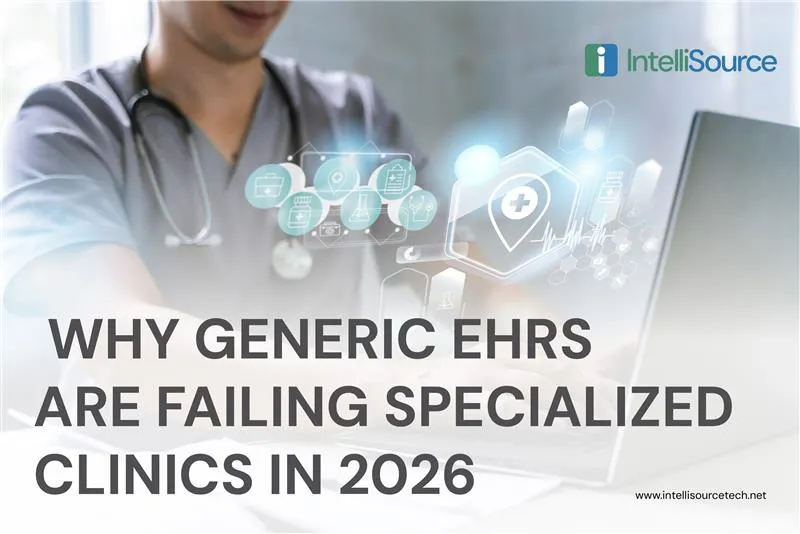
By the year 2026, healthcare software is not only a support service; it is the backbone of clinical efficiency, safety, and scaling for the business. However, many specialized medical clinics today remain dependent upon Generic Electronic Healthcare Records Software solutions. Electronic Record (EHR) systems that were not designed with their processes in mind. Although big EHR systems boast the ability to standardize, they unsoften fail when considered with regard to the specialized healthcare field such as dermatology clinics, fertility clinics, oncology centers, mental health practices, and Diagnostic Labs. This mounting disparity has forced healthcare leaders to rethink their technology strategy. Notably, clinics are increasingly adopting personalized healthcare software development to overcome the limitations of generic systems to assume control of their operations.
1. The "One-Size-Fits-None" Problem
The generic EHR is designed for use within hospitals and multi-specialty groups. As a result, they focus more on general functionality as opposed to specialization. In practices and/or clinics, this leads to friction during all levels of provision of care. Specialized clinics may need: • Custom clinical templates and structured data capture • Specialty-specific coding and billing logic • Unique diagnostic workflows • Integration with proprietary medical devices or lab systems Large EHR platforms such as Epic or Cerner could support these needs technically, but only through heavy customization, long implementation cycles, and high costs. Even then, clinics are forced to adjust their processes to the software and not vice-versa. This is where healthcare software development companies offering tailored solutions have a clear advantage. Designing software around real-world clinical workflows, tailored solutions eliminate unnecessary steps and reduce operational complexity.
2. Physician Burnout and the UI/UX Crisis
Poor physician burnout has reached alarming levels in 2026. Usability of healthcare software continues to play a significant role. Generic EHR interfaces are clunky, generally slow, and often counterintuitive — mostly for specialists who require quick access to a small but crucial section of data. Usability issues often include: • Too many clicks for regular activities • Poorly organized patient dashboards • Non-intuitive navigation across modules • Poor optimization on mobiles or tablets These issues increase documentation time, reduce face-to-face patient interaction, and negatively impact clinical outcomes. Custom healthcare software development addresses the UI/UX crisis head-on. Companies like IntelliSource develop customized modules that layer on top of legacy EHRs. The modules simplify interfaces, automate repetitive tasks, and present data in a clinician-friendly format without forcing clinics to replace their existing systems. The result is improved physician satisfaction, reduced burnout, and better patient experiences.
3. Custom Workflow Development Using FHIR APIs
Interoperability has emerged as the foundation of current healthcare software, and FHIR (Fast Healthcare Interoperability Resources) APIs are at the center of this transformation. In 2026, FHIR enables clinics to extend the capabilities of their existing EHRs without disrupting their systems. Custom software development based on the use of the FHIR API has the ability to: • Develop specialty-specific workflows • Synchronize real-time patient data • Support secure integration with third-party services • Handle advanced analytics and reporting
For instance, a fertility center may develop a personalized workflow for tracking embryos that fully integrates into its EHR, lab, and patient portal. Likewise, a mental health clinic may devise personalized care plans and tracking tools that cooperate with therapy procedures. Through the use of FHIR, healthcare software development companies such as IntelliSource ensure compliance alongside flexibility — a challenge typical of general EHR systems.
4. Enhancing Patient Flow Efficiency through Customized Healthcare Apps
Scalability, expressed in terms of patient throughput, is an important aspect for specialty clinics. Delays in scheduling, documentation, diagnosis, or billing can have a large impact on revenues as well as patient satisfaction. The generic EHR systems usually do not have the flexibility required to fully optimize these processes. Customized healthcare apps, however, can be developed to streamline the whole care experience. Key areas where custom apps can make a difference are: • Smart appointment scheduling & queue management • Electronic intake forms and pre-visit questionnaires • Tracking real-time clinical tasks • Efficient discharge and billing processes For example, a diagnostic clinic of specialists can develop its own application to coordinate technicians, machines, and reports in real time — dramatically shortening patient waiting times. When developed by an experienced software development company, these applications seamlessly integrate with current EHR systems and provide measurable efficiency gains.
Why Custom Healthcare Software Development Is the Future
As healthcare continues to evolve, specialization will only increase. Clinics that rely solely on generic EHRs risk falling behind in efficiency, clinician satisfaction, and patient outcomes. There are the following advantages when developing custom healthcare software: • Alignment of workflow and clinical reality • Scalable & Modular Architecture • More intuitive UI/UX for clinicians & staff • Innovation without EHR Replacement Leading healthcare software development companies like IntelliSource focus on building custom modules and applications that complement — not compete with — existing EHR investments.
Conclusion
In the year 2026, generic failure in specialist clinics is not a theoretical issue — it is an ongoing operational reality. From usability to limited interoperability, one-size-fits-all healthcare software is progressively proving inadequate. Through investment in custom software development services, specialized clinics can reassert control, minimize burnout, optimize patient efficiency, and future-proof their operations. The future looks like this: healthcare software has to adapt to the clinics, not the other way around.
Ready to Modernize Your Healthcare Software? Specialized clinics don't need to replace their EHRs to innovate. With IntelliSource's custom healthcare software development approach, you can extend existing systems using FHIR APIs, clinician-first UI/UX, and workflow-specific applications. Whether you are a single-specialty clinic or a growing healthcare network, our team helps you design scalable, compliant, and high-performance solutions tailored to your practice. Talk to IntelliSource — a trusted healthcare software development company — to build software that fits your clinic, not the other way around.
Blogs:
Explore all blog

Cloud Migration Gone Wrong: 7 Costly Mistakes and How to Avoid Them
38% of enterprise cloud migrations blow past their budget. Discover the 7 most common cloud migration mistakes, why they happen, and how to avoid them before a single workload moves.
Digital Transformation Checklist for Businesses: 10 Signs Your Company Is Falling Behind
Most companies falling behind digitally don't know it yet. Use this digital transformation checklist for businesses to score yourself across 10 real signs — each with a measurable business cost attached.
Beyond the Hype: 3 Ways We Are Integrating OpenAI APIs to Cut Operational Costs for SMEs
SMEs don't need to build their own AI systems to benefit. Discover 3 practical ways IntelliSource integrates OpenAI APIs to cut operational costs and automate the work no one wants to do manually.